

The effectiveness of any CCTV system depends not only on the cameras but also on how video is transmitted and stored. Transmission and storage play a central role in determining the system’s performance, reliability, and scalability.
Poor transmission can lead to signal loss or image degradation, while inadequate storage may result in gaps in footage or poor-quality playback.
For commercial environments, where consistent video quality and long-term storage are often required, understanding these technical aspects is critical.
Choosing the right transmission method affects how far video signals can travel without interference or delay. Similarly, selecting the right type of recording system and data compression format ensures that footage is stored efficiently without compromising visual clarity.
Whether you are planning a small surveillance setup or a large multi-site deployment, having a clear grasp of wired versus wireless transmission options, the role of DVRs and NVRs, and how compression formats impact storage will help you make informed decisions.
This guide will walk through each of these core elements, providing a practical overview of what to consider and how each choice affects overall system performance.
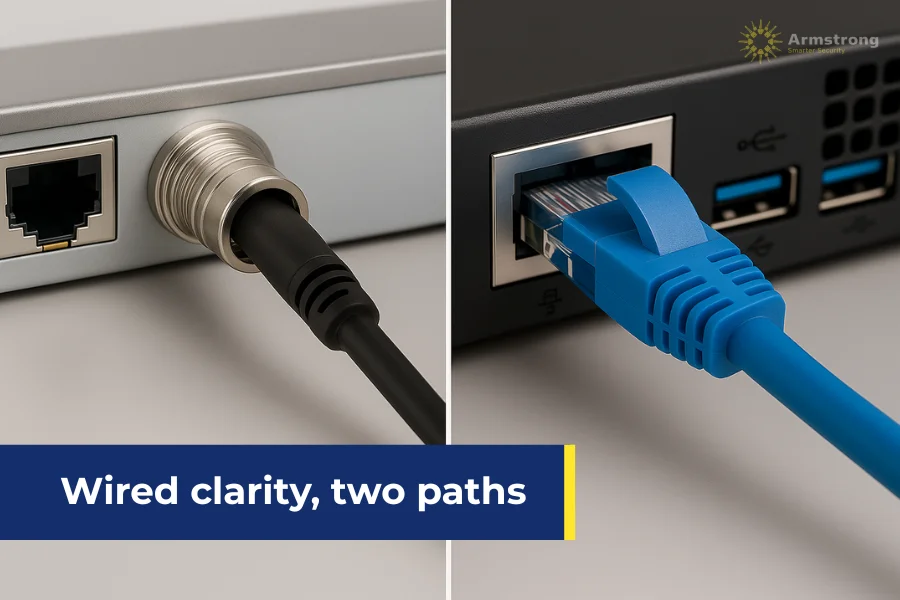
Wired transmission is the backbone of most reliable CCTV systems. It offers stable signal delivery, consistent image quality, and minimal interference, making it the preferred choice for many commercial installations.
The type of cable used directly influences video clarity, distance coverage, and system scalability. Understanding the differences between coaxial, twisted pair, and fibre optic cabling helps ensure your CCTV system performs as expected in its operating environment.
Coaxial cable has long been used in analogue CCTV systems and remains in service today, especially in legacy installations or budget-conscious projects. It consists of a central conductor, insulation, a metallic shield, and an outer jacket.
Advantages:
Limitations:
Coaxial cable may still be practical for smaller sites or when upgrading an existing analogue system without a full overhaul.
Twisted pair cables, especially Cat5e and Cat6, are standard in modern IP CCTV systems. They are commonly used in networking and support, both data and power transmission, when paired with PoE.
Advantages:
Limitations:
Twisted pair cabling offers a strong balance of flexibility, cost-efficiency, and performance, especially in buildings with existing Ethernet infrastructure.
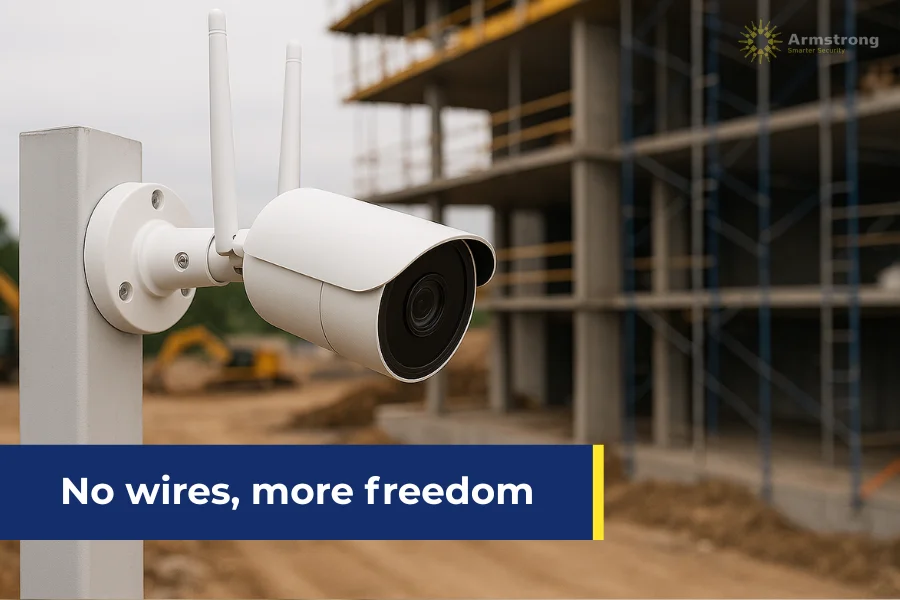
Wireless CCTV transmission offers an alternative to traditional cabling, particularly useful in areas where installing physical wiring is difficult, expensive, or disruptive.
While not as universally reliable as wired systems, wireless technology has advanced significantly, making it a viable solution for many surveillance applications.
The choice to go wireless depends on the specific layout of the site, the need for flexibility, and the intended use of the cameras.
Wireless CCTV systems typically rely on radio frequency (RF) or microwave signals to transmit video from the camera to the receiver. These methods can eliminate the need for cables and support rapid deployment.
Applications:
Advantages:
Limitations:
Wireless CCTV works best in low to moderate density environments or as a short-term solution where mobility and speed are more important than long-term bandwidth and stability.
When planning to implement a wireless surveillance system, a few critical factors should be addressed to avoid performance issues:
Signal Strength and Range
Wireless cameras must be within the effective transmission range of the receiver. Obstructions such as walls, metal structures, or electrical equipment can weaken signals.
Network Congestion
In environments with heavy Wi-Fi usage, interference may affect video transmission. Dedicated frequencies or dual-band routers can help reduce this issue.
Security
Wireless signals must be encrypted to prevent unauthorised access to video feeds. Look for systems with secure transmission protocols and multi-level user access.
Power Supply
While the data may be wireless, most cameras still require local power unless using battery or solar-powered options, which may require additional maintenance.
Wireless CCTV offers convenience and flexibility, but it is important to carefully evaluate environmental conditions and use cases to ensure it is the right choice for the setting.
Recording and storing surveillance footage is a core function of any CCTV system. The choice between a Digital Video Recorder (DVR) and a Network Video Recorder (NVR) is influenced by the type of cameras in use, the system architecture, and the level of scalability needed.
Understanding how these two systems differ will help ensure compatibility, performance, and ease of use in both new installations and upgrades.
DVRs are typically used in analogue CCTV systems. In this setup, each camera is directly connected to the recorder using coaxial cables. The DVR processes the video signal on-site, compresses it, and stores it on an internal hard drive.
Key Features:
Advantages:
Limitations:
DVRs are ideal for users who want a straightforward, budget-friendly system and do not require advanced networking features.
NVRs are designed for use with IP camera systems. Unlike DVRs, NVRs do not process video signals; instead, they receive digital video streams that have already been encoded by the camera. These streams are transmitted over a network and stored on the recorder.
Key Features:
Advantages:
Limitations:
NVRs are suitable for users seeking a flexible, future-ready surveillance solution with advanced functionality and easy remote access.
To select the right recorder, consider the following:
Selecting the appropriate recorder ensures that your surveillance system functions efficiently, with the right balance of cost, quality, and expandability.
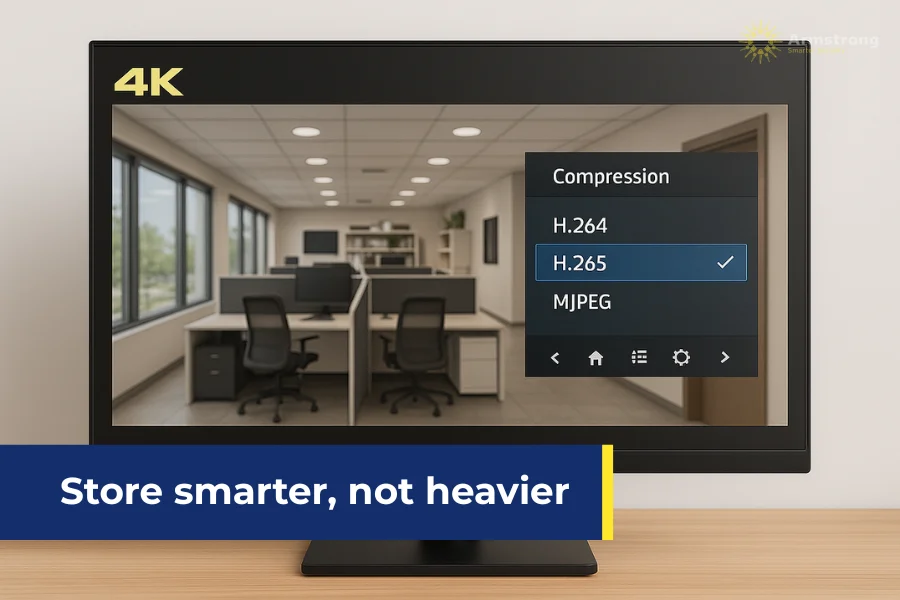
As surveillance systems grow in complexity and resolution, the volume of recorded video increases significantly. Without efficient data compression, storage demands would quickly become unmanageable. Compression technology reduces the size of video files without severely affecting visual quality, allowing CCTV systems to store more footage, reduce bandwidth usage, and improve remote access speed.
H.264, also known as Advanced Video Coding (AVC), has been the industry standard for many years. It offers a strong balance between compression rate and image quality, making it suitable for most standard and high-definition CCTV systems.
H.265, or High Efficiency Video Coding (HEVC), is the next-generation compression standard. It offers up to 50 per cent better compression than H.264 while maintaining the same level of quality. This is particularly beneficial for systems using high-resolution cameras, such as 4K or for networks with limited bandwidth.
Comparison:
For most new installations using IP cameras, H.265 provides better long-term efficiency, especially when paired with high-capacity NVRs.
MJPEG compresses each frame of video as an individual JPEG image. It does not use inter-frame compression like H.264 or H.265, which means it requires significantly more bandwidth and storage.
Advantages:
Limitations:
MJPEG may be suitable in systems where clarity in individual frames is more important than overall storage efficiency, but it is less practical for general surveillance use due to its storage demands.
Choosing the right compression standard depends on system requirements:
Compression settings can often be adjusted within the camera or recorder. System administrators should tailor these settings to the expected recording conditions, balancing storage capacity, video quality, and the time period footage must be retained.
Understanding the technical components behind video transmission and storage is key to building a reliable and efficient CCTV system.
The type of cabling affects how well video signals travel, especially across large or complex sites. Wireless options offer flexibility, but come with limitations that must be carefully considered for stability and security.
Choosing the right recording device is equally important. DVRs are suited for analogue systems and small-scale setups, while NVRs provide scalability, higher video quality, and modern integration features for IP-based systems.
Both serve different needs and should be selected based on existing infrastructure and long-term goals.
Compression formats such as H.264, H.265, and MJPEG play a major role in managing storage requirements and maintaining video quality. H.265, in particular, offers the efficiency needed for modern, high-resolution systems, while MJPEG remains a specialised choice for scenarios requiring high detail in each frame.
By aligning transmission methods, recording systems, and compression settings with the specific demands of the installation, businesses can ensure that their surveillance setup is both technically sound and future-ready.
This approach not only maximises performance and storage efficiency but also supports better decision-making through consistent, high-quality video capture.

© 2026 | Armstrong Smarter Security | All Rights Reserved | Designed by 
If this is an emergency or urgent job, please contact us on 0800-506-111